Julian Calendar 2100
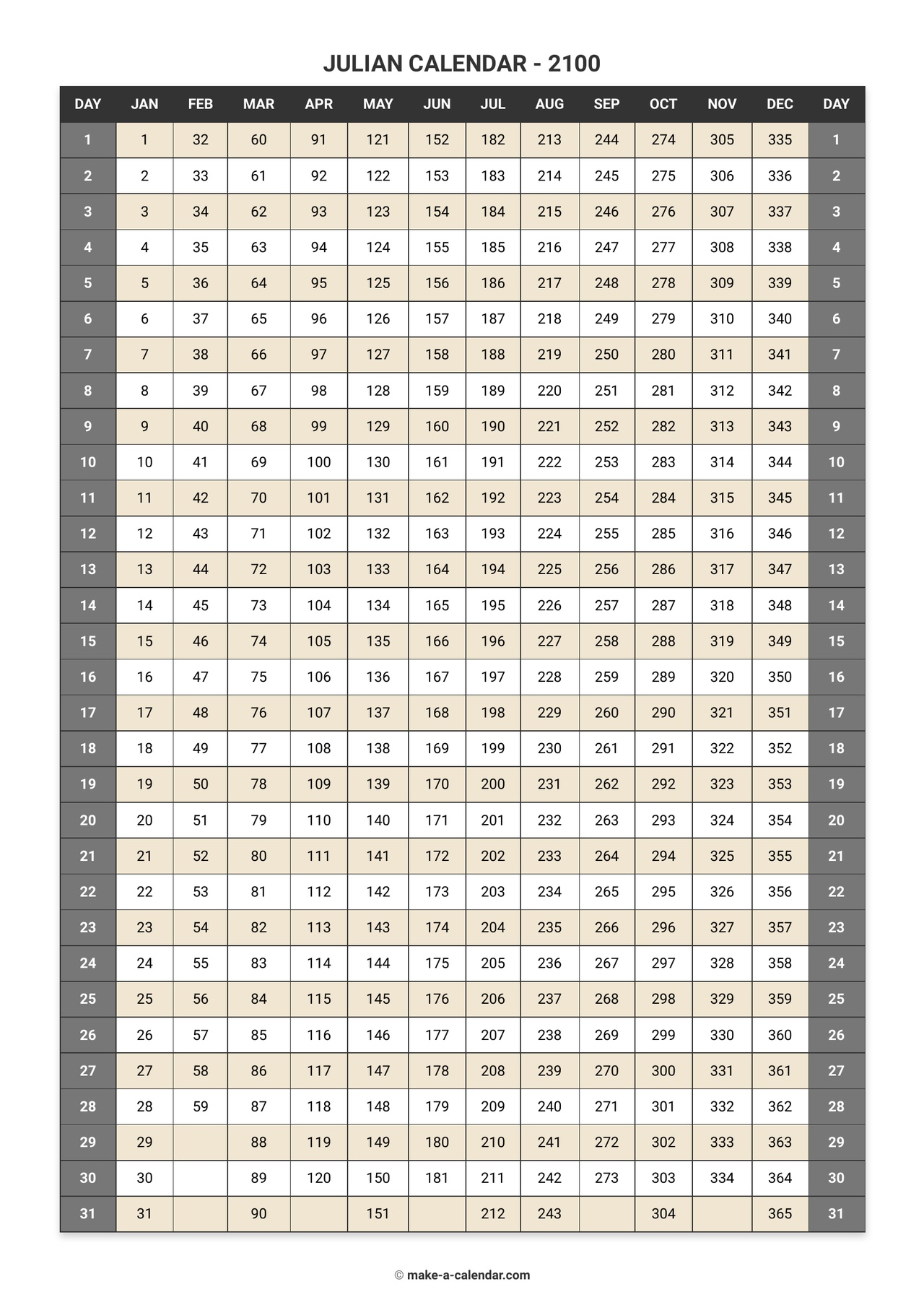
Day numbers 1–365 beside month/day columns — quick lot-code lookup.
 Download PDF
UTC · JDN · Free PDF
Day-of-year PDF tables for 2100 plus an astronomical Julian Date converter. Today (UTC): 24-Oct-2026 · JDN 2461338
The Julian calendar hub on Make a Calendar combines two ideas people call Julian date: the industry day-of-year code printed on cartons and logs, and the continuous astronomical day count astronomers label Julian Date (JD). Printable PDF grids for 2100, a live converter, and batch decoding live on one page so production clerks and science students stop mixing the meanings.
In manufacturing, Julian date often means ordinal day: January 1 equals 001, December 31 equals 365 in common years or 366 in leap years. A stamp 241 on a dairy case means the 241st day of the year—not the historical Julian calendar Rome used. Leap years insert February 29 as day 060 and push every later code by one. Confirm whether 2100 is a leap year on leap year before auditing spring inventory.
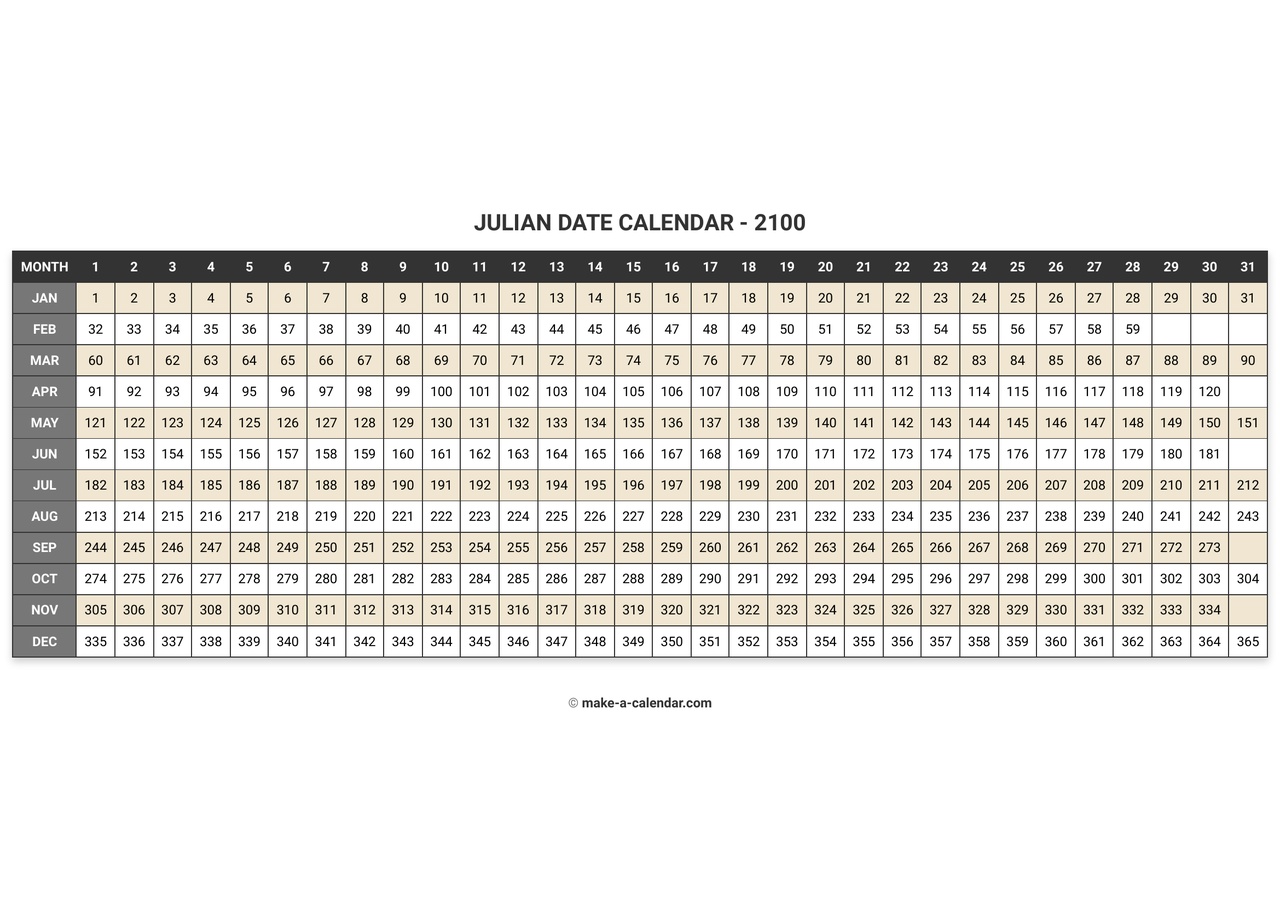
Two PDF layouts ship from this hub: a column lookup table and a month grid with running ordinals. Print at 100% scale on Letter or A4 portrait for desk reference. Pair a wall sheet with the full month view from yearly calendars 2100 when buyers need month names alongside codes.
Julian Date in astronomy is a continuous count of days from a fixed epoch, with a fractional part for time of day. The integer part is the Julian Day Number (JDN). Modified Julian Date (MJD) subtracts 2,400,000.5 for compact storage in satellite logs. This avoids calendar reform jumps when you integrate observations across centuries.
The converter accepts calendar date and UTC time, then returns JD, JDN, and weekday. For MJD-only workflows, open modified Julian date or Julian day number. Keep PDF ordinals separate from JD math—adding 001 to a JD is meaningless.
The Julian calendar introduced by Julius Caesar used a simpler leap rule and drifted against seasons until the Gregorian reform of 1582. Some Orthodox churches still use Julian calendar dates for fixed feasts, which is why Christmas can appear on different civil dates than Western December 25. That religious calendar is not the same as JD serial numbers in a telescope archive.
When a coworker says Julian date, ask which lane they mean before converting. Warehouse staff usually want YYDDD or three-digit ordinals. Observatory staff want JD at UTC noon conventions. This page serves both audiences with labeled sections.
Paste multiple YYDDD or YYYY-DDD tokens to decode batches of lot codes during recalls or freshness audits. The grid view marks every day of 2100 with ordinal numbers so you can spot whether a stamped 366 belongs to a leap year label or a data entry mistake.
Cross-check decoded dates against day of the week when investigating whether a code could plausibly match production logs. Combine with days between dates for shelf-life spans measured in calendar days.
A quality team receives complaints about product stamped 032. They decode to February 1 in a common year, confirm 2100 leap status, open the PDF grid, and verify the plant uses Gregorian ordinals starting January 1 equals 001. The batch decoder flags any code above 365 in a common year as invalid.
An astronomy club member converts a partial eclipse timestamp to JD for comparing with a handbook table. They enter UTC time, read JD, and share JDN in the club forum without reformatting the civil date three times.
Laminate the single-page ordinal PDF for loading docks where gloves and glare make phone screens awkward. Replace the sheet every January—last year's leap pattern misleads clerks in the new year.
Digital planners still benefit from the converter when ERP systems export odd date strings. Paste into JD-to-calendar mode rather than trusting mental math across month boundaries.
When Excel stores true dates, exporting to YYDDD for labels requires a custom format or helper column—do not concatenate month and day mentally across year boundaries. ERP systems sometimes emit Julian strings with a leading year digit; the batch decoder accepts common variants so receiving clerks catch typos before pallets mix.
If your plant switches from ordinal codes to ISO yyyy-mm-dd mid-year, run both decoders on sample rows during UAT week. Training slides should show side-by-side examples from 2100 so night shift and day shift use the same vocabulary at handoff.
Ordinal PDFs follow the Gregorian civil calendar for 2100. JD conversion uses standard algorithms suitable for education and field astronomy, not legal metrology. Sub-millisecond timing for finance or litigation needs certified libraries.
Historical dates before local adoption of Gregorian reform carry historian caveats the converter may not model per city. Modern 2100 logistics and contemporary sky logs are the sweet spot.
Cold-chain auditors compare carton Julian codes to delivery manifests during spot checks. Decode the stamped ordinal, confirm it plausibly precedes the delivery scan timestamp, and flag codes above year length in common years before product reaches retail. Pair decoded dates with days-between math when shelf-life policies cite maximum calendar days from production.
Plants that restart ordinal sequences after line sanitation should document reset events in shift logs—otherwise a low code after a high code looks like time travel to receiving clerks.
Intro astronomy courses ask students to convert observation timestamps to JD for comparing with textbook tables. Stress UTC entry when laptops auto-display local time zones. JDN integers are easier to paste into lab reports than full JD fractions when instructors grade midnight rounding separately from daytime labs.
Satellite operators querying historical observations may see both MJD and JD in metadata—confirm which column your archive uses before joining to 2100 ordinal tables. Food traceability teams should keep YYDDD decode separate from astronomical JD in SOP headings so new hires do not apply the wrong converter during a recall drill.
Explore converters, ordinal date, and date tools. Week numbers: 2100 weeks.
Manufacturing often uses Julian date as day-of-year codes—January 1 equals 001 through December 31. Astronomers use Julian Date as a continuous day count from a fixed epoch, often with a fractional time part. This hub serves both with labeled sections. Ask coworkers which meaning they need before converting.
In many plants, 241 means the 241st day of the year. Decode with the grid or batch tool, then confirm whether the plant uses Gregorian ordinals starting January 1 equals 001. Codes above 365 in a common year or above 366 in a leap year often signal data entry errors worth rejecting at receiving.
Julian Date includes a fractional part for time of day. Julian Day Number is the integer day count. Modified Julian Date subtracts 2,400,000.5 for compact logs. Use the modified Julian date or Julian day number pages when your workflow expects MJD or JDN only—not three-digit packaging codes.
The hub explains the historical Julian calendar reform for context, but ordinal PDFs follow the Gregorian civil calendar for the active year. Religious Julian calendar feasts are a separate topic from JD serial numbers in telescope archives. Modern logistics and contemporary sky logs are the primary use case here.
Yes—paste multiple YYDDD or YYYY-DDD tokens into the batch decoder during recalls or freshness audits. Cross-check decoded civil dates against day-of-week when investigating whether a code plausibly matches production logs. Pair with days between dates for shelf-life spans measured in calendar days.
Algorithms follow standard Jean Meeus methods suitable for education and field astronomy. Sub-millisecond timing for finance or litigation needs certified libraries. Historical dates before local Gregorian adoption carry historian caveats the converter may not model per city. Enter UTC time carefully when comparing with handbook tables.
Live UTC calendar date with day-of-year codes and astronomical Julian Date numbers.
Convert calendar dates to YYDDD, YJJJ, and YYYYJJJ — or decode day-of-year back to a date.
Add a compact day-of-year widget to your site via iframe.
Paste a packaging or manufacturing code (4, 5, or 7 digits) to reveal the production date.
Common formats: YYDDD (5 digits, e.g. 26068 = day 68 of 2026), YJJJ (4 digits), YYYYJJJ (7 digits). Used on food labels and industrial lot stamps.
Day numbers 1–365 beside month/day columns — quick lot-code lookup.
Download PDF
Each month in rows with running day-of-year numbers.
 Download PDF
Industry day-of-year codes are above. This tool calculates astronomical JD, JDN, and MJD in UTC.
Click any day to see DOY and YYDDD for 2100.